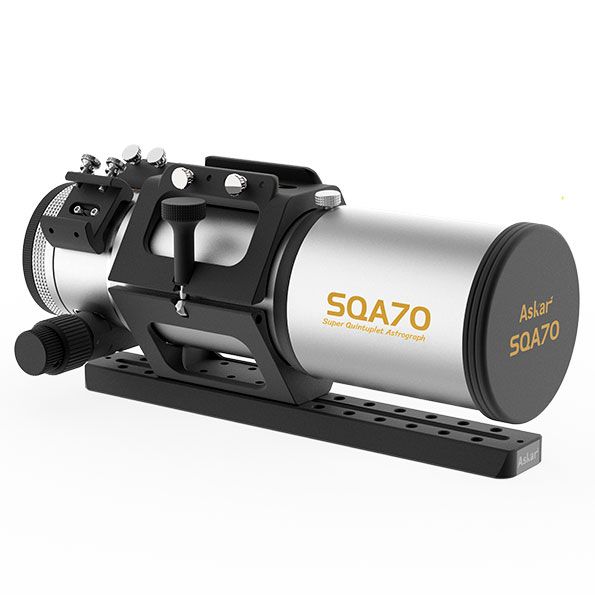

Askar SQA70 vs Sky-Watcher Evostar 72ED: Upgrade or Stay?
For owners of the Sky-Watcher Evostar 72ED considering a higher-end astrophotography refractor, the Askar SQA70 offers a notable step up in optical design and imaging capabilities. This comparison cuts through the specs to evaluate whether investing in the Askar SQA70 is a worthwhile upgrade or if sticking with the Evostar 72ED remains the smarter choice for your astrophotography goals. We focus on key decision factors such as optical quality, mount compatibility, price, and portability to help you decide which scope fits your needs best.
Quick Verdict
The Askar SQA70 delivers superior optical performance with its quintuplet flat-field design, yielding sharper, coma-free stars across a wide field—a meaningful advantage for deep sky imaging and advanced astrophotography setups. However, this improvement comes at a higher price point and requires a more capable mount due to its increased weight and size. The Sky-Watcher Evostar 72ED remains a solid, budget-friendly option for those prioritizing affordability and simpler portability without demanding the absolute best optical edge. Choose the Askar SQA70 if your imaging ambitions and gear support the upgrade; otherwise, the Evostar 72ED continues to serve well for intermediate astrophotographers on a tighter budget.
Key Differences at a Glance
- Optical Quality: Askar SQA70 features a quintuplet design delivering flatter fields and sharper stars than the triplet ED design of the Evostar 72ED.
- Mount Compatibility: The heavier Askar SQA70 demands a sturdier equatorial mount with a payload capacity above 10 lbs, whereas the Evostar 72ED is lighter and more mount-flexible.
- Price: The Askar SQA70 carries a noticeable price premium (~$319), reflecting its advanced optics and build, compared to the more affordable Evostar 72ED.
- Portability: The Evostar 72ED is lighter and more compact, favoring users who prioritize ease of transport and setup.
- Astrophotography Performance: The Askar SQA70 supports full-frame imaging with less need for additional flatteners, while the Evostar 72ED typically requires extra accessories for optimal results.
Price and Value
The Askar SQA70 is positioned at a higher price tier, generally around $319 for the optical tube alone. This cost reflects its sophisticated quintuplet optical design, high-precision CNC machining, and compatibility with advanced accessories like electronic focusers and off-axis guiders. Buyers upgrading from the Evostar 72ED, which is significantly more affordable, should weigh whether the optical and feature enhancements justify the investment.
In terms of value, the Evostar 72ED remains attractive for those entering or progressing in astrophotography without the budget for a premium flat-field refractor. It offers good optical quality for its price, making it a sensible choice for budget-conscious hobbyists. However, users seeking the sharpest stars and widest, coma-free fields—especially with full-frame cameras—may find the Askar SQA70’s price premium justified by the improved imaging results and reduced need for supplementary optics.
Performance and Practical Use
Optical performance is the heart of this comparison. The Askar SQA70’s quintuplet lens assembly provides a flat field with minimal coma and chromatic aberration across the entire imaging frame. This design is particularly advantageous for deep sky astrophotography, where sharp, pinpoint stars from corner to corner are essential. The 70 mm aperture and 336 mm focal length (f/4.8) balance wide-field views with sufficient resolution for capturing star clusters, nebulae, and galaxies with excellent detail.
By contrast, the Evostar 72ED uses a triplet ED design that performs well but exhibits slightly more field curvature and coma, especially towards the edges of the frame. This often necessitates adding a field flattener or reducer to achieve comparable image quality, which adds to the setup complexity and cost. For casual imaging or users with smaller APS-C sensors, these drawbacks may be less critical.
- Askar SQA70: Superior star sharpness and flatness; reduced need for additional flatteners; ideal for full-frame sensors and advanced cameras.
- Evostar 72ED: Good basic optical quality; requires field flattener/reducer for best results; suited for smaller sensors or less demanding imaging.
In practical astrophotography use, the Askar SQA70’s integrated features such as a dual-speed focuser and built-in dew shield add to performance consistency and ease of focusing during long imaging sessions. The Evostar 72ED’s simpler focuser and design are reliable but less refined, which may affect fine focus adjustments in demanding conditions.
Ease of Setup / Ease of Use
The Evostar 72ED’s lighter weight and smaller size generally make it easier to handle, mount, and transport. Its compatibility with a wider range of mounts, including some lighter equatorial mounts, lowers the barrier to getting started or setting up in different locations. This ease of use benefits users who prioritize quick deployment and portability.
Conversely, the Askar SQA70, while more compact than some high-end refractors, is heavier and demands a robust mount to ensure stable tracking and imaging. Setting up the SQA70 may require more attention to balancing and mount alignment, especially given its higher payload and accessory compatibility. Users must also consider the time and cost of acquiring compatible accessories like electronic focusers or off-axis guiders to fully exploit the scope’s capabilities.
- Evostar 72ED: More beginner-friendly setup; lighter and more mount-compatible; simpler focuser design.
- Askar SQA70: Requires stronger mounts; more involved accessory integration; advanced focuser aids precision but adds complexity.
Accessories / Feature Completeness
The Askar SQA70 comes equipped with several integrated features that enhance astrophotography workflows. These include a built-in dew shield to reduce moisture buildup, a high-quality dual-speed focuser for precise control, and native compatibility with electronic automatic focusers (EAF), filter wheels (EFW mini), and off-axis guiders (OAG). These features collectively support advanced imaging setups and reduce the need for aftermarket modifications.
In contrast, the Evostar 72ED is a more straightforward optical tube without these integrated astrophotography-focused features. Users frequently add external dew shields, field flatteners, and focusers to achieve comparable results. While this modularity offers flexibility, it often leads to incremental costs and increased setup complexity.
- Askar SQA70: Integrated dew shield; dual-speed CNC focuser; seamless compatibility with EAF, filter wheels, and OAGs.
- Evostar 72ED: Basic focuser and tube; requires additional accessories for dew control and field flattening; less plug-and-play for advanced astrophotography.
Which Buyer Should Choose Which Option?
Choose the Askar SQA70 if you:
- Are an intermediate to advanced astrophotographer aiming for top-tier deep sky imaging quality with full-frame or larger sensors.
- Have or plan to acquire a sturdy equatorial mount that can handle 10+ lbs payload comfortably.
- Value integrated features like a built-in dew shield, dual-speed focuser, and native accessory compatibility to streamline your imaging workflow.
- Prioritize optical flatness, minimal coma, and sharp stars across the entire field without relying heavily on external flatteners.
- Are willing to invest in a higher upfront cost for a more capable, future-proof astrophotography setup.
Choose the Sky-Watcher Evostar 72ED if you:
- Are budget-conscious and prefer a more affordable upgrade from beginner scopes without the complexity of advanced optics.
- Use smaller camera sensors (APS-C or smaller) where field curvature and coma are less impactful.
- Require a lighter, more portable scope that works well on a wider range of mounts, including lighter equatorial mounts.
- Prefer a simpler setup where you can add accessories gradually based on evolving needs.
- Focus on casual or entry-level astrophotography where ultimate optical perfection is not the primary concern.
Conclusion
Upgrading from the Sky-Watcher Evostar 72ED to the Askar SQA70 represents a significant step forward in optical design and astrophotography readiness. The SQA70’s quintuplet flat-field optics, precision focuser, and integrated dew shield deliver noticeable improvements in image sharpness and ease of use for serious deep sky imaging. However, these benefits come with increased costs, greater weight, and the need for a stable, capable mount.
If your astrophotography ambitions include advanced imaging with full-frame sensors and you have or plan to invest in the necessary supporting gear, the Askar SQA70 is a compelling upgrade that can elevate your results substantially. On the other hand, if you are satisfied with good-quality images on a budget, prefer lighter equipment, or are still growing your imaging skills, the Evostar 72ED remains a practical and dependable choice.
Ultimately, the decision hinges on your priorities: optical and feature enhancements versus price and portability. Evaluate your current setup, imaging goals, and budget carefully to determine which refractor best aligns with your astrophotography journey.